Forklift Battery Charger Compatibility: What Voltage, Amp-Hour Rating, and Battery Chemistry Mean
October 11, 2026 3:24 pmFor warehouses, manufacturers, and material handling operations in Jefferson, WI, a forklift that cannot hold a charge can quickly disrupt the workday. Whether equipment is moving pallets through a distribution facility or supporting production at a local manufacturing plant, the right battery charger helps keep operations running efficiently.
Choosing a compatible forklift battery charger involves more than matching a plug or selecting a charger with enough power. Battery voltage, amp-hour capacity, and chemistry all determine whether a charger can safely and effectively support your equipment.
Quick Answer: A forklift battery charger must match the battery’s nominal voltage, support its amp-hour (Ah) capacity, and use a charging profile approved for its battery chemistry. Lead-acid, AGM, gel, and lithium-ion batteries have different charging requirements. An incompatible charger can cause incomplete charging, excessive heat, battery damage, or equipment downtime.
For Jefferson-area businesses, understanding these specifications can make charger selection, battery replacement, and fleet maintenance more straightforward.
What Local Forklift Operators Should Know
-
A 36-volt forklift battery generally requires a charger designed for a 36-volt battery system, not a 24-volt or 48-volt charger.
-
Amp-hour capacity helps determine appropriate charger output and expected charging time.
-
Battery chemistry determines the charging algorithm, voltage limits, and temperature protections required.
-
Jefferson County facilities operating multiple forklift models should verify charger compatibility for each battery rather than assuming chargers are interchangeable.
-
Wisconsin’s cold winters can affect battery performance and charging conditions, especially in unheated storage or loading areas.
At Remis Power Systems Inc, we understand how important dependable battery charging is to material handling operations. Our focus is helping businesses understand the electrical requirements and equipment considerations that affect reliable battery performance.
How Does Forklift Battery Voltage Affect Charger Compatibility?
Forklift battery voltage determines the nominal voltage rating a compatible charger must support. Common industrial forklift battery systems include 24V, 36V, 48V, and 80V configurations, although other systems exist. The charger must be designed and configured for the battery’s voltage and chemistry.
For example, a Jefferson warehouse using a 36V electric forklift should not connect its battery to a conventional 48V-only charger.
A charger with the wrong voltage rating may fail to charge the battery properly or expose it to unsafe electrical conditions.
Operators should check three items before connecting equipment:
-
The nominal voltage listed on the battery nameplate.
-
The charger’s supported battery voltage.
-
The manufacturer’s approved charging configuration.
It is also important to understand that nominal voltage is not the same as the voltage measured during charging. A properly configured charger may operate above the battery’s nominal voltage as part of its approved charging cycle.
Facilities near Jefferson’s industrial and commercial corridors can reduce charging errors by clearly labeling chargers and their assigned batteries.
What Does a Forklift Battery’s Amp-Hour Rating Mean?
A forklift battery’s amp-hour rating describes its electrical charge capacity under a specified test rate. For example, a 48V, 600Ah battery has a nominal energy capacity of approximately 28.8 kilowatt-hours, although usable energy varies with operating conditions, battery chemistry, age, and discharge limits.
The amp-hour rating helps determine how much charging current is appropriate.
A battery with a larger Ah rating may require more time to recharge when using the same charger output.
Consider two batteries:
| Battery | Nominal Capacity | Charging Consideration |
|---|---|---|
| 36V, 400Ah | 14.4 kWh | Requires a compatible 36V charger sized for its capacity |
| 36V, 750Ah | 27 kWh | May require greater charging output to meet the same turnaround time |
Both batteries use the same nominal voltage, but their charging requirements can differ substantially.
For manufacturing and warehouse operations in Jefferson, charger sizing should reflect the battery’s approved charging rate and the time available between shifts.
A charger that delivers too little current may take longer than the operation allows. Excessive current, on the other hand, may cause overheating or battery deterioration if it exceeds the manufacturer’s specifications.
Why Does Battery Chemistry Matter When Choosing a Charger?
Battery chemistry determines which charging profile, voltage limits, safety controls, and maintenance procedures a forklift charger must use. Flooded lead-acid, AGM, gel, and lithium-ion batteries cannot automatically share the same charger, even when their nominal voltage and amp-hour ratings match.
This is especially relevant for Jefferson County businesses upgrading older electric forklift fleets or introducing lithium-ion equipment.
Flooded Lead-Acid Batteries
Flooded lead-acid batteries are widely used in industrial material handling equipment. They typically require multi-stage charging, temperature management, ventilation, and periodic electrolyte maintenance.
Some also require manufacturer-approved equalization charging.
AGM and Gel Batteries
Absorbent glass mat (AGM) and gel batteries are sealed lead-acid designs with specific voltage and charging current requirements.
They generally should not receive the same equalization treatment used for certain flooded lead-acid batteries.
Lithium-Ion Batteries
Lithium-ion forklift batteries typically require charging equipment that is compatible with the battery management system (BMS).
Depending on the design, communication between the charger and BMS may be required to control current, voltage, temperature, and charging termination.
A charger designed for flooded lead-acid batteries should never be assumed compatible with lithium-ion batteries without explicit manufacturer approval.
What Charging Conditions Matter for Jefferson, WI, Facilities?
Charging conditions in Jefferson, WI, can be affected by seasonal temperature changes, equipment usage, and the physical layout of a facility. Wisconsin winters can create colder charging environments, while summer heat and poorly ventilated battery rooms may contribute to elevated operating temperatures.
These factors matter because batteries do not respond to temperature changes in identical ways.
Flooded lead-acid batteries can experience reduced charging efficiency and capacity in cold conditions. Lithium-ion batteries may restrict charging at low temperatures to protect their cells.
Facilities with loading docks, unheated equipment storage areas, or temperature-variable warehouses should pay particular attention to manufacturer-specified charging temperature limits.
Local operators should also consider electrical supply capacity, charger placement, ventilation requirements, and the accessibility of charging stations.
A properly matched charger still needs a suitable installation environment.
What Are the Warning Signs of an Incompatible Forklift Battery Charger?
Warning signs of an incompatible forklift battery charger include repeated charging faults, unusual battery temperatures, incomplete charging cycles, and battery performance that declines after charging. These symptoms do not always mean the charger is incompatible, but they warrant investigation before continued use.
Watch for these seven indicators:
-
Frequent charger fault codes: The charger repeatedly stops or displays an error during charging.
-
Excessive battery heating: The battery becomes unusually hot compared with normal operation.
-
Incomplete charging: The charger terminates the cycle before the battery reaches its expected state of charge.
-
Long charging times: Charging consistently takes longer than the equipment’s normal operating schedule allows.
-
Unexpected battery maintenance problems: Flooded lead-acid batteries experience unusual water consumption or electrolyte issues.
-
Reduced forklift runtime: The forklift operates for noticeably shorter periods despite apparently completing a charge.
-
Communication errors: A lithium-ion charger cannot establish the required communication with the battery management system.
For businesses in Jefferson, Fort Atkinson, and surrounding communities, investigating these symptoms early can help avoid unnecessary interruptions during busy production periods.
When Should a Professional Check Forklift Charger Compatibility?
A professional should evaluate forklift charger compatibility whenever a battery is replaced, a different charger is introduced, charging faults persist, or the facility changes battery chemistry. These situations require verification of electrical specifications, charging profiles, connector arrangements, and manufacturer requirements.
Operators can safely review equipment labels, record charger fault codes, and inspect accessible connectors for visible damage without opening electrical enclosures.
However, internal charger repairs, electrical testing, connector modifications, and battery system adjustments should be handled by qualified personnel.
If a battery overheats, leaks, produces unusual odors, or shows visible damage, stop charging and follow the facility’s safety procedures.
For Jefferson-area operations, a compatibility review is particularly useful when introducing new forklifts into an existing fleet.
What Commonly Causes Forklift Battery Charging Problems?
Forklift battery charging problems commonly result from mismatched electrical specifications, unsuitable charging profiles, damaged connections, battery deterioration, or environmental conditions. In Jefferson County facilities, these issues may become more noticeable when equipment usage increases or batteries are charged in temperature-variable environments.
Common causes include:
1. Incorrect Voltage Selection
A charger configured for a different battery voltage may fail to charge properly or create unsafe conditions.
2. Improper Charger Current
A charger that is not appropriately sized for the battery’s capacity and approved charging rate can lead to excessive charging time or battery stress.
3. Battery Chemistry Mismatch
Using the wrong charging algorithm may damage the battery even when the nominal voltage matches.
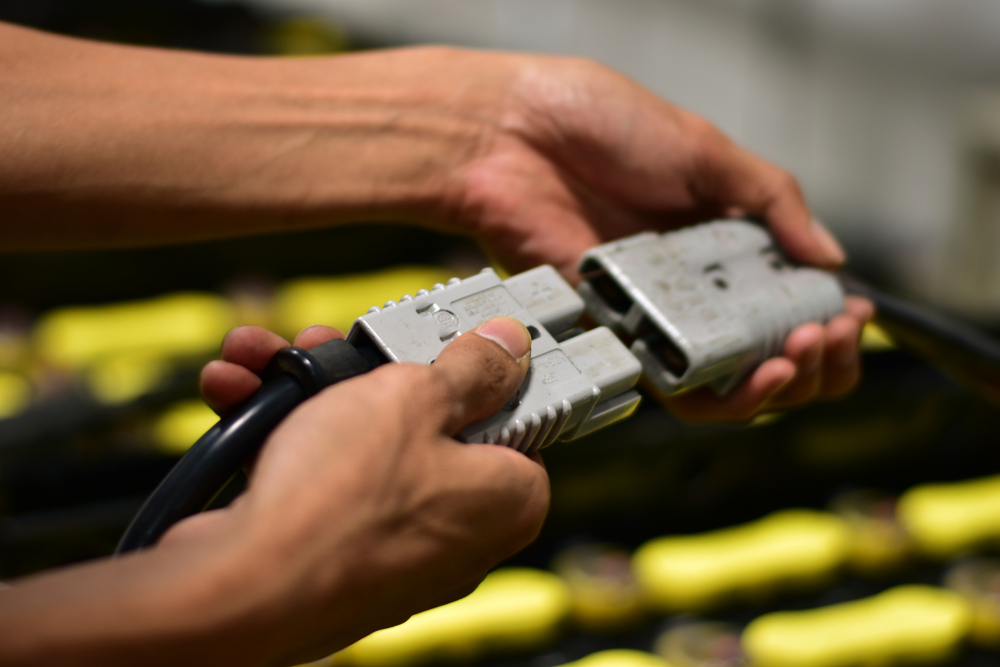
4. Worn or Damaged Connectors
Loose, corroded, or damaged connections can cause resistance, heating, and intermittent charging failures.
5. Battery Aging
An older battery may have reduced capacity or increased internal resistance, making charging problems more noticeable.
6. Temperature Conditions
Cold storage environments, high ambient temperatures, and inadequate ventilation can interfere with normal charging behavior.
Identifying the actual cause is essential before replacing equipment.
How Can Jefferson Businesses Prevent Forklift Charger Compatibility Problems?
Jefferson businesses can prevent many forklift charger compatibility problems by maintaining accurate battery records, verifying charger settings, inspecting connections, and following manufacturer-approved charging procedures. Consistent preventive maintenance is especially valuable for facilities operating multiple forklifts across different shifts.
A practical maintenance routine includes:
-
Record each battery’s voltage, amp-hour rating, chemistry, model, and approved charger requirements.
-
Label chargers and charging locations to reduce accidental mismatches.
-
Inspect accessible charging cables and connectors for wear, discoloration, or physical damage.
-
Keep charging areas clean, appropriately ventilated, and within the equipment’s specified temperature range.
-
Follow manufacturer recommendations for flooded lead-acid battery watering and equalization.
-
Review charger fault histories and investigate recurring problems.
-
Schedule compatibility checks when batteries, forklifts, or chargers are replaced.
Before Wisconsin’s colder months, facilities should also confirm that battery storage and charging temperatures remain within approved limits.
Operators should not adjust charging voltages, bypass safety controls, or modify connectors without appropriate technical authorization.
What Results Can Businesses Expect From a Properly Matched Charger?
A properly matched forklift battery charger should deliver the manufacturer’s intended charging profile while supporting safe battery operation and practical charging schedules. For Jefferson manufacturers and distribution facilities, this can mean more predictable charging cycles, fewer avoidable compatibility faults, and improved fleet planning.
Appropriate charger selection may help support:
-
More consistent battery charging.
-
Reduced risk of overcharging or undercharging.
-
Better alignment between charging time and shift schedules.
-
Protection against avoidable battery stress.
-
More effective use of charging equipment.
Results depend on battery condition, charger design, operating temperatures, maintenance practices, and daily workload.
A compatible charger cannot restore lost capacity in a severely deteriorated battery, but it can help prevent additional problems caused by improper charging.
What Are Common Mistakes When Selecting Forklift Battery Chargers?
Common forklift charger selection mistakes include matching voltage alone, overlooking amp-hour capacity, ignoring battery chemistry, and assuming that compatible connectors guarantee compatible charging. These mistakes can be costly for Jefferson operations that depend on electric forklifts throughout the workday.
| Mistake | Possible Consequence | Better Approach |
|---|---|---|
| Matching only battery voltage | Incorrect charging current or profile | Verify voltage, Ah rating, and chemistry |
| Assuming all 48V batteries charge alike | Battery damage or charging faults | Check the exact battery model and approved profile |
| Choosing based only on charging speed | Excessive charging current | Follow manufacturer current limits |
| Reusing a lead-acid charger for lithium-ion | Communication or charging incompatibility | Confirm explicit lithium-ion compatibility |
| Ignoring connector specifications | Poor connections or unsafe modifications | Verify connector type, rating, and polarity |
| Overlooking facility electrical requirements | Installation or power supply problems | Review charger input requirements with qualified personnel |
A charger should be selected for the complete battery system, not just a single specification.
Common Local Scenario: Replacing a Forklift Battery in a Jefferson Warehouse
A common local scenario involves a Jefferson warehouse replacing an aging flooded lead-acid forklift battery while keeping its existing charger. The replacement battery may have the same nominal voltage but a different amp-hour rating or chemistry.
For example, the facility might replace a 36V, 600Ah flooded lead-acid battery with a 36V lithium-ion system.
Although both batteries are rated at 36V, their charging requirements may be substantially different.
The existing charger may lack the correct lithium-ion charging profile, communication capability, or manufacturer approval.
Before returning the forklift to service, the facility should verify the replacement battery’s specifications, charger compatibility, connector requirements, and charging location conditions.
This is a hypothetical example, not a documented customer project. It illustrates why a battery replacement should trigger a charging system review.
What Services Help Resolve Forklift Battery Charging Problems?
Forklift battery charging problems can be addressed through compatibility assessments, battery condition evaluations, charger diagnostics, charging system maintenance, and properly specified equipment replacement. The appropriate solution depends on whether the issue originates with the battery, charger, connections, or operating environment.
For Jefferson-area businesses, relevant service needs may include:
-
Evaluating battery and charger specifications.
-
Identifying charger fault conditions.
-
Assessing charging performance and battery condition.
-
Reviewing charging equipment during fleet upgrades.
-
Determining whether an existing charger can support a replacement battery.
-
Planning appropriate charging equipment for changing operational demands.
At Remis Power Systems Inc, we encourage businesses to review the full charging system before making equipment decisions.
How Should Businesses Compare Charger Repair, Reconfiguration, and Replacement?
Businesses should compare charger repair, reconfiguration, and replacement based on the existing equipment’s condition, manufacturer-supported capabilities, battery requirements, and operational needs. A working charger is not necessarily compatible with a new battery, while a charging fault does not automatically mean the charger must be replaced.
| Option | When It May Make Sense |
|---|---|
| Charger repair | Existing charger is compatible but has a repairable fault |
| Charger reconfiguration | Manufacturer permits settings or profiles to be changed for the intended battery |
| Charger replacement | Existing equipment cannot safely support the battery’s specifications |
| Battery evaluation | Charging complaints may be caused by battery deterioration |
| Charging system review | Multiple forklifts, batteries, or chargers are being introduced or reorganized |
For operations with tight shift schedules, charging capacity and equipment availability should be considered alongside purchase and repair costs.
Which Areas Around Jefferson May Face Similar Forklift Charging Challenges?
Industrial and commercial facilities in Jefferson, Fort Atkinson, Watertown, Lake Mills, Johnson Creek, and Whitewater may encounter similar battery charger compatibility questions as they maintain or upgrade electric material handling equipment.
Across Jefferson County and nearby southeastern Wisconsin communities, manufacturers, warehouses, and distribution operations can benefit from checking charging specifications before replacing batteries or changing fleet configurations.
What Is the Cost of Ignoring Charger Compatibility Problems?
Ignoring forklift charger compatibility problems can lead to battery damage, charging delays, unexpected equipment downtime, and avoidable repair or replacement expenses. The financial impact varies with fleet size, battery type, operational demands, and the severity of the mismatch.
For a Jefferson facility that relies on electric forklifts to support production or shipping, even one unavailable truck can complicate workflow planning.
Repeatedly attempting to charge an incompatible battery can also create unnecessary safety risks.
A timely compatibility assessment is generally a more controlled approach than waiting for repeated faults or battery failure.
Frequently Asked Questions About Forklift Battery Charger Compatibility
Can I use a 48V charger on a 36V forklift battery?
No, a conventional 48V-only forklift charger should not be used on a 36V battery. The higher charging voltage may damage the battery or create unsafe operating conditions. A charger must be designed and configured for the battery’s nominal voltage and chemistry. Always confirm manufacturer approval before connecting equipment.
How do I know what size charger my forklift battery needs in Jefferson, WI?
Start by checking the battery nameplate for voltage, amp-hour capacity, and chemistry. Then compare those specifications with the charger’s supported battery range, charging current, and manufacturer recommendations. Jefferson businesses should also consider available charging time, facility electrical capacity, and operating temperatures when selecting equipment.
Can one forklift charger work with different amp-hour batteries?
Yes, some forklift chargers support a range of amp-hour capacities, provided the voltage, chemistry, charging current, and manufacturer requirements are compatible. Multi-profile or programmable chargers may offer additional flexibility. However, a charger should never be assumed suitable for a different battery simply because the connector fits.
Are lithium-ion forklift chargers different from lead-acid chargers?
Yes, lithium-ion forklift batteries often require different charging algorithms and communication with a battery management system. Lead-acid chargers may use charging stages or equalization procedures unsuitable for lithium-ion batteries. Some chargers support multiple chemistries, but the exact battery and charger combination must be explicitly approved.
Does Wisconsin winter weather affect forklift battery charging?
Yes, cold temperatures can affect battery charging behavior, available capacity, and charging time. Lithium-ion systems may restrict charging below specified temperature limits, while lead-acid batteries also experience temperature-related performance changes. Jefferson County facilities with unheated storage or loading areas should follow the manufacturer’s operating temperature requirements.
How long should a forklift battery take to charge?
Forklift battery charging time depends on battery capacity, charger output, chemistry, state of charge, and operating temperature. Some systems are designed for overnight charging, while others support faster or opportunity charging. Jefferson facilities should size their charging systems around manufacturer limits and actual shift schedules rather than assuming one charging duration fits every battery.
Should I replace my forklift charger when upgrading to lithium-ion in Jefferson?
You may need to replace your charger when upgrading to lithium-ion, particularly if the existing charger does not support the required charging profile or battery management system communication. Some equipment can be reconfigured with manufacturer approval. A compatibility review should occur before installing the replacement battery.
What should I do if my forklift charger keeps showing fault codes?
Stop repeated charging attempts and identify the fault code using the charger’s documentation. Check for obvious external issues only when it is safe to do so. If the problem continues, arrange qualified diagnostics. Jefferson-area operators should avoid bypassing protective controls or modifying charger settings without authorization.
Can a charger with the wrong amp rating damage a forklift battery?
Yes, excessive charging current can contribute to overheating, battery stress, or damage if it exceeds the manufacturer’s limits. A lower-current charger may charge too slowly for operational needs. The correct output depends on battery capacity, chemistry, charging profile, and the battery manufacturer’s approved charging specifications.
How often should Jefferson County businesses review charger compatibility?
Charger compatibility should be reviewed whenever batteries, chargers, or forklifts are replaced or reassigned. Periodic checks are also useful for facilities with mixed equipment fleets or changing charging schedules. Reviewing specifications during routine maintenance can help Jefferson County businesses identify mismatches before they cause charging interruptions.
Keep Your Forklift Fleet Charging Reliably in Jefferson, WI
Forklift battery charger compatibility depends on more than voltage alone. Amp-hour capacity, battery chemistry, charger settings, connector requirements, and operating conditions all influence whether a charging system is suitable for your equipment.
For Jefferson businesses, understanding these factors helps protect battery investments, support safer charging practices, and reduce preventable equipment downtime.
At Remis Power Systems Inc, we believe informed equipment decisions begin with understanding the specifications that matter.
Protect Your Forklift Batteries and Reduce Charging Downtime
Get clarity on your battery and charger requirements before a compatibility problem affects your operations.
Categorised in: Forklift Batteries
This post was written by admin
Comments are closed here.