
Why Battery Watering Systems Are Essential for Lead-Acid Battery Health
April 28, 2026 2:06 pmLead-acid batteries have powered industrial equipment for well over a century, and despite the rise of lithium-ion alternatives, they remain the backbone of countless warehouse operations, manufacturing facilities, and logistics centers around the world. Forklifts, floor scrubbers, pallet jacks, and other heavy-duty equipment depend on these batteries to get through demanding shifts day after day.
But here is the truth that many operators overlook: the single most important maintenance task for keeping these batteries alive is also one of the most neglected. Proper hydration through battery watering systems is not optional. It is the difference between a battery that lasts five years and one that fails in two.
The Science Behind Lead-Acid Battery Maintenance
To understand why watering matters so much, you need a basic grasp of how lead-acid batteries work. These batteries generate electricity through a chemical reaction between lead plates and a sulfuric acid electrolyte solution. Water is a critical component of that electrolyte. During the charging process, electrolysis causes the water molecules in the solution to break down into hydrogen and oxygen gases, which then escape from the battery as vapor. This is a normal and unavoidable part of how the battery functions.
The problem begins when that lost water is not replaced. As the water level drops, the concentration of sulfuric acid in the electrolyte increases, and the lead plates inside the battery begin to be exposed to air. Exposed plates suffer from a process called sulfation, where lead sulfate crystals form on the plate surfaces and reduce the battery’s ability to hold and deliver a charge. Once significant sulfation occurs, it is extremely difficult to reverse. The battery loses capacity, cycles faster, and eventually fails long before its expected lifespan.
Consistent lead-acid battery maintenance, centered on keeping electrolyte levels within the correct range, prevents this chain of events from ever starting. The right water level protects the plates, stabilizes the chemical reactions, and allows the battery to perform at its rated capacity through hundreds of charge cycles.
How Battery Watering Systems Solve a Critical Problem
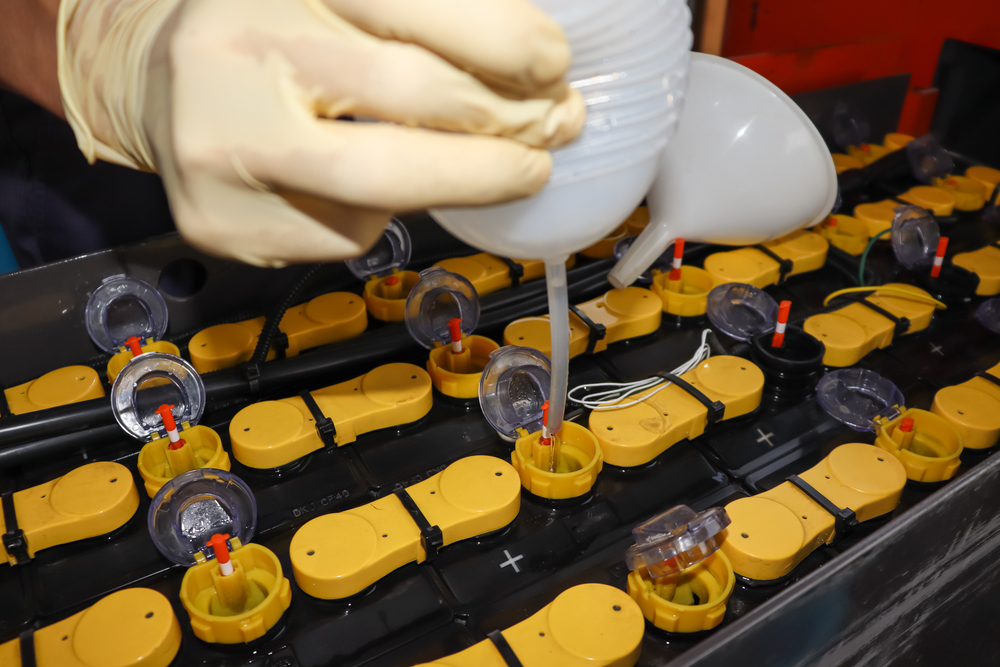
Manual watering has always been the traditional approach. A technician walks through the facility, removes vent caps from each battery cell, checks the water level with a flashlight or float indicator, and adds distilled water with a pitcher or handheld filler. On paper, it sounds simple enough. In practice, it is time-consuming, inconsistent, and prone to human error. Cells get overfilled, underfilled, or skipped entirely. In a busy warehouse where dozens of batteries cycle through the chargers daily, manual checks often get deprioritized.
Battery watering systems solve this problem by automating or dramatically simplifying the process. These systems use a network of tubing and flow-control valves connected to each cell’s vent cap. When a battery needs water, the system delivers the precise amount needed to bring each cell to the correct level, and then stops automatically. There is no guesswork, no overflow, and no dry cells. An operator connects the water line, fills the battery in seconds, and disconnects. That is it.
For facilities managing large fleets, the time savings alone justify the investment. But the real value is in the consistency. Every cell gets the right amount of water every time, which means every battery gets the protection it needs to perform at its best.
Industrial Battery Watering: Choosing the Right System for Your Fleet
Not all battery watering systems are created equal, and choosing the right one for your operation requires thinking carefully about fleet size, battery types, and operational demands. Industrial battery watering setups generally fall into a few categories based on how water is delivered and monitored.
Single-point watering systems are the most common solution for forklift batteries and other industrial applications. These systems connect all cells in a battery pack through a single manifold, so the entire battery can be watered through one connection point rather than opening each cell individually. This is where the term forklift battery watering system most often applies, since these vehicles carry large multi-cell battery packs that would take considerable time to water manually.
Gravity-fed systems rely on a water tank positioned above the batteries, using natural pressure to push water through the lines. These are cost-effective and reliable for facilities with straightforward layouts. Pressurized systems offer more flexibility in where the water supply can be placed and are better suited for larger or more complex facilities. Some advanced systems integrate sensors and monitoring technology that alert maintenance staff when a battery has been watered, when water levels are running low, or when a valve may be malfunctioning.
When selecting a system, consider the size of your battery fleet, the physical layout of your charging area, and whether your team needs basic simplicity or more robust monitoring capability. Working with a supplier who specializes in industrial battery watering ensures you get a setup that fits your specific operation rather than a one-size-fits-all solution.
Extend Battery Life Lead-Acid: The Long-Term ROI of Consistent Watering
The financial case for investing in battery watering systems is compelling when you look at the full cost picture. A quality forklift battery can cost anywhere from one thousand to several thousand dollars depending on voltage and capacity. Most lead-acid batteries are rated for a lifespan of 1,500 charge cycles or roughly five years of regular use when properly maintained. Without consistent watering, that lifespan can be cut in half or worse.
The goal to extend battery life in lead-acid applications is not just about saving money on replacement costs, though that alone is significant. It also reduces downtime caused by failing batteries, lowers the environmental impact of premature disposal, and keeps your equipment running at peak efficiency. A degraded battery does not just hold less charge; it also charges less efficiently, generates more heat, and puts stress on the charger and the vehicle’s electrical system.
Facilities that implement proper battery watering programs consistently report longer average battery lifespans, reduced replacement frequency, and lower overall energy costs per cycle. Some operations see payback on their watering system investment within the first year simply through reduced battery replacements and labor savings from eliminated manual watering rounds.
It is also worth noting that most battery manufacturers require documented evidence of proper maintenance, including regular watering, to honor warranty claims. A battery watering system creates an inherently more consistent and verifiable maintenance record than manual spot checks, which can protect your investment if a warranty issue arises.
Conclusion
Lead-acid batteries are a significant investment for any operation that relies on electric-powered industrial equipment. Protecting that investment comes down to one foundational practice: keeping those batteries properly hydrated through consistent, accurate watering. Battery watering systems remove the guesswork, reduce labor, and ensure every cell gets the care it needs on every cycle. Whether you manage a small fleet or hundreds of batteries across a large distribution center, implementing a reliable industrial battery watering program is one of the smartest and most cost-effective decisions you can make for your equipment and your bottom line.
Need Industrial Battery Supply in Jefferson, WI?
Remis Power Systems Inc has been a family-owned and operated business since 1980. We have become an industry-leading supplier of industrial batteries and chargers. We proudly maintain an impressive inventory of new and certified reconditioned Deka products for all your industrial battery needs. When you do business with, Remis Power Systems, you will find honest and experienced professionals who see things your way! We recognized each one of you had different needs and will work with you to customize our services to your needs. Whether you are in the market for a new or used battery, service program or unplanned service breakdown, we will be there to find the right solution for YOU! Contact us today!
Categorised in: Battery Watering Systems
This post was written by admin
Comments are closed here.